RainCast:高分辨率 72 小时短期降水预报模型
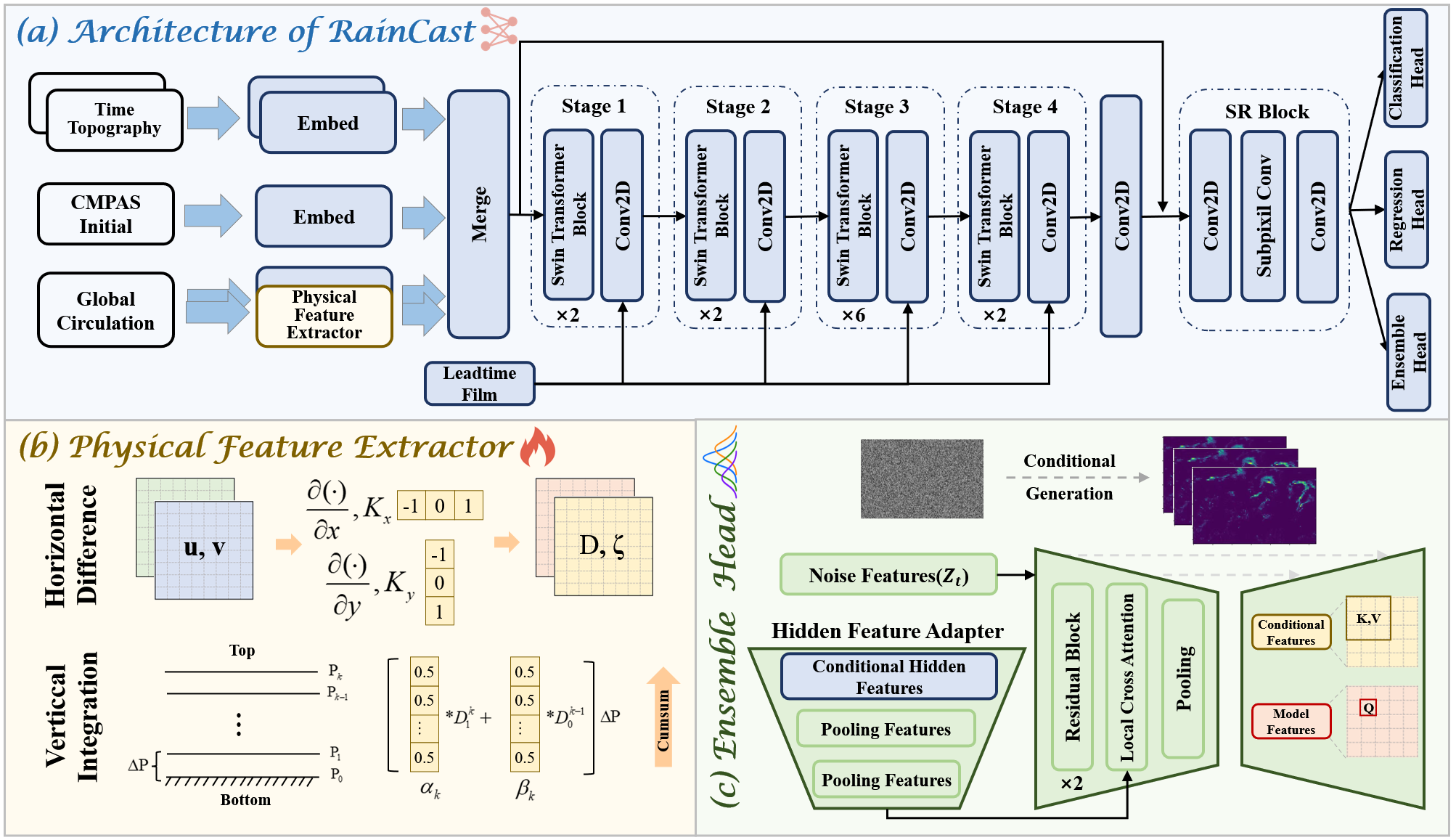
我的论文 RainCast: A High-Resolution 72-Hour Short-Term Precipitation Forecasting Model 已发表于 KDD 2026。RainCast 面向中国区域,以 0.05° 空间分辨率生成未来 72 小时逐小时降水预报,同时支持确定性预测与概率集合预测。
论文链接:ACM Digital Library
开源代码:GitHub - NJUHML/RainCast
发表信息
| 项目 | 信息 |
|---|---|
| 论文题目 | RainCast: A High-Resolution 72-Hour Short-Term Precipitation Forecasting Model |
| 作者 | Guanlong Ma, Weiqi Chen, Yang Zhao, Huiling Yuan, Liang Sun |
| 会议 | The 32nd ACM SIGKDD Conference on Knowledge Discovery and Data Mining(KDD ‘26) |
| 论文集 | Proceedings of the 32nd ACM SIGKDD Conference on Knowledge Discovery and Data Mining V.2 |
| 页码 | 11621–11632 |
| ISBN | 979-8-4007-2259-2 |
| DOI | 10.1145/3770855.3818880 |
| 许可 | CC BY 4.0 |
Guanlong Ma 与 Weiqi Chen 为共同第一作者;Huiling Yuan 与 Liang Sun 为通讯作者。
论文摘要
准确的短期降水预报需要预测未来 3 天内的降水演变,但极端降水样本稀缺、降水过程具有复杂的多尺度物理机制,使这一任务长期面临挑战。现有回归或分类式深度学习方法容易产生过度平滑的降水场,缺少明确的物理引导,对预报不确定性的刻画也较为有限;依赖雷达外推的临近预报方法则难以扩展到多日尺度。
为解决这些问题,我们提出 RainCast:一个面向中国区域、空间分辨率为 0.05°、预报时效最长为 72 小时的逐小时高分辨率降水预报框架。模型包含两个关键设计:
- 物理引导的特征提取器:借鉴连续方程诊断思想,从环流场中提取涡度、散度以及与垂直运动相关的信号,将气象物理先验融入数据驱动模型。
- 多预测头设计:通过回归头生成确定性预报,并通过集合头生成概率多成员预报,以减轻降水场的过度平滑并量化预报不确定性。
实验结果表明,RainCast 在多个基线上取得稳定提升。对于 24 小时累计降水达到 50 mm 的强降水事件,RainCast 相比 GFS 的 CSI 最高提升 62.82%;与 GEFS 相比,集合预报的 CRPS 平均降低 19.35%。可解释性分析还发现,600 hPa 温度是东亚降水预报中的重要信号,这可能与冻结层和融化层附近的水成物相态转换有关。
核心贡献
- 将短期降水预报时效扩展至 72 小时,并保持 0.05° 高空间分辨率与逐小时输出。
- 设计可学习的物理特征提取器,引入散度、涡度和垂直运动相关信息;在 0.1 mm/24 h 阈值上,物理模块使 CSI 提升 12.2%。
- 以回归、分类和集合预测头统一确定性预报与概率预报,其中集合头基于 Rectified Flow 生成多成员结果。
- 通过可解释性分析揭示 600 hPa 温度对东亚降水预报的重要作用,为数据驱动模型与气象机理之间建立联系。
Our paper, RainCast: A High-Resolution 72-Hour Short-Term Precipitation Forecasting Model, has been published at KDD 2026. RainCast produces hourly precipitation forecasts over China for lead times up to 72 hours at 0.05° spatial resolution, supporting both deterministic and probabilistic ensemble prediction.
Paper: ACM Digital Library
Code: GitHub - NJUHML/RainCast
Publication Information
| Item | Details |
|---|---|
| Title | RainCast: A High-Resolution 72-Hour Short-Term Precipitation Forecasting Model |
| Authors | Guanlong Ma, Weiqi Chen, Yang Zhao, Huiling Yuan, Liang Sun |
| Conference | The 32nd ACM SIGKDD Conference on Knowledge Discovery and Data Mining (KDD ‘26) |
| Proceedings | Proceedings of the 32nd ACM SIGKDD Conference on Knowledge Discovery and Data Mining V.2 |
| Pages | 11621–11632 |
| ISBN | 979-8-4007-2259-2 |
| DOI | 10.1145/3770855.3818880 |
| License | CC BY 4.0 |
Guanlong Ma and Weiqi Chen contributed equally. Huiling Yuan and Liang Sun are the corresponding authors.
Abstract
Reliable short-term precipitation forecasting up to three days ahead remains difficult because extreme rainfall samples are scarce and precipitation is governed by nonlinear, multiscale physical processes. Existing regression- and classification-based deep learning methods often generate overly smooth precipitation fields, provide little explicit physical guidance, and have limited ability to represent forecast uncertainty. Radar-based nowcasting methods, meanwhile, are not designed for multi-day prediction.
We introduce RainCast, a high-resolution framework that generates hourly precipitation forecasts over China up to 72 hours ahead at 0.05° resolution. It contains two central components:
- A physics-guided feature extractor inspired by continuity-equation diagnostics, which derives vorticity, divergence, and vertical-motion-related signals from atmospheric circulation fields.
- A multi-head prediction design that combines deterministic regression forecasts with probabilistic multi-member ensemble forecasts, reducing spatial over-smoothing while representing uncertainty.
RainCast consistently outperforms the evaluated baselines. For heavy rainfall events reaching 50 mm in 24 hours, its CSI improvement over GFS is as high as 62.82%. Its ensemble forecasts reduce CRPS by 19.35% on average compared with GEFS. The interpretability study also identifies 600-hPa temperature as an important signal for East Asian precipitation, potentially reflecting hydrometeor phase transitions near the freezing–melting layer.
Main Contributions
- Extends high-resolution short-term precipitation prediction to 72 hours with hourly output at 0.05° resolution.
- Introduces a learnable physical feature extractor for divergence, vorticity, and vertical-motion-related information; the module improves CSI by 12.2% at the 0.1 mm/24 h threshold.
- Unifies deterministic and probabilistic forecasting through regression, classification, and ensemble heads, with the ensemble head using Rectified Flow to generate multiple members.
- Connects model interpretation with meteorological mechanisms by highlighting the role of 600-hPa temperature in East Asian precipitation forecasting.